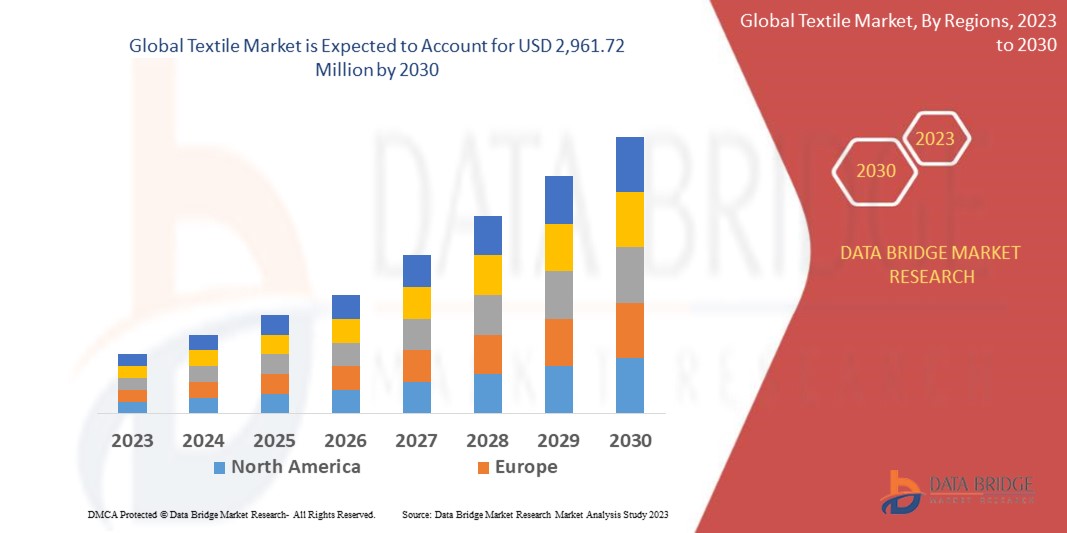
This Textile Market research report is a painstaking investigation of current scenario of the market and future estimations, which covers several market dynamics. The report sheds lamp on market size, regional changing trends emerging new prospects for market growth rate and production value estimation from 2020 - 2026. The report serves the analysis of the global market share, segmentation, revenue growth estimation and geographic regions of the market. The industry report is a great resource, which provides current and upcoming technical and financial details of the industry. The international Textile Market analysis report provides top-to-bottom analysis and estimation of various market-related factors that play a key role in better decision-making.
What is more, Textile Market research report highlights numerous industry verticals such as company profile, contact details of manufacturer, product specifications, geographical scope, production value, market structures, recent developments, revenue analysis, market shares and possible sales volume of the company. To achieve actionable market insights to build sustainable and money-spinning business strategies with an ease, this market research report is a great option. A team of enthusiastic analysts, skilled researchers and experienced forecasters work meticulously to generate such kind of market report. The Textile report describes CAGR (compound annual growth rate) values and its fluctuations for the specific forecast period.
Find out what’s next for the Textile Market with exclusive insights and opportunities. Download full report:
https://www.databridgemarketresearch.com/reports/global-textile-market
Textile Market Dynamics
Segments
- Product Type: The global textile market can be segmented based on product type into fabrics, fibers, and yarn. Fabrics segment includes various types such as cotton, polyester, viscose, silk, and wool among others. Fibers segment consists of natural fibers like cotton and wool, as well as synthetic fibers like polyester and nylon. Yarn segment comprises different types like cotton yarn, synthetic yarn, and blended yarn.
- Application: Textile market can be further segmented based on application into apparel, home textile, technical textile, and industrial textile. The apparel segment covers clothing and fashion items, while the home textile segment includes products like bed linens, towels, and curtains. Technical textiles are used in industries like automotive, construction, and healthcare for specialized purposes. Industrial textiles are utilized in various industrial applications for their strength and durability.
- Distribution Channel: The market can also be segmented by distribution channel into online retail and offline retail. Online retail is gaining popularity due to the increasing digitalization and convenience it offers to customers. Offline retail includes traditional brick-and-mortar stores where customers can physically visit and purchase textiles.
Market Players
- Some of the key players in the global textile market include:
- Luthai Textile Co., Ltd.: A leading textile manufacturer based in China known for its high-quality fabrics and innovative designs.
- Welspun India Ltd.: One of the largest home textile manufacturers in India, specializing in bed linens and towels.
- Lenzing AG: A prominent fiber producer known for its sustainable and eco-friendly TENCEL™ and Modal fibers.
- The Dow Chemical Company: Produces high-performance fibers for technical textile applications in industries like automotive and construction.
- Toray Industries, Inc.: Japanese multinational company offering a wide range of textile products including fibers, fabrics, and garments.
These market players play a crucial role in shaping the global textile market with their products, innovations, and market strategies. Competition among these players drives the industry towards continuous improvement and innovation to meet the ever-changing demands of consumers worldwide.
The global textile market is experiencing significant growth due to factors such as increasing disposable income, changing consumer preferences, and the rising demand for sustainable and eco-friendly textiles. One notable trend in the market is the growing popularity of technical textiles, especially in industries like automotive and healthcare, where advanced textile materials are being used for their functional properties such as durability, strength, and resistance to chemicals. This trend is driving the demand for innovative textile solutions tailored to specific industrial needs, leading to collaborations between textile manufacturers and industrial players to develop high-performance materials.
Another key trend in the textile market is the emphasis on sustainability and eco-friendliness across the entire textile supply chain. Consumers are becoming more conscious of the environmental impact of their purchases, leading to a surge in demand for textiles made from organic, recycled, or biodegradable materials. Market players are responding to this trend by adopting sustainable practices in their manufacturing processes, sourcing materials responsibly, and investing in research and development to create eco-friendly textile products. Additionally, regulatory bodies are imposing stringent environmental standards on the textile industry, pushing manufacturers to adopt sustainable practices to comply with regulations and meet consumer expectations.
The emergence of online retail channels is transforming the textile market by providing consumers with easy access to a wide range of products and brands from the comfort of their homes. Online platforms offer convenience, competitive pricing, and a personalized shopping experience, driving the growth of e-commerce in the textile sector. This shift towards online channels is prompting traditional brick-and-mortar retailers to enhance their digital presence and omnichannel strategies to stay competitive in the market. Furthermore, advancements in digital technologies such as augmented reality and virtual fitting rooms are revolutionizing the way consumers shop for textiles online, further fueling the growth of e-commerce in the industry.
Supply chain disruptions caused by the COVID-19 pandemic have also impacted the global textile market, leading to disruptions in manufacturing operations, raw material shortages, and delays in product delivery. However, the industry has demonstrated resilience by adapting to the new normal through digitalization, remote working, and implementing health and safety measures to ensure business continuity. As the world gradually recovers from the pandemic, the textile market is expected to bounce back stronger, driven by pent-up demand, innovation, and a renewed focus on sustainability and technological advancements.
In conclusion, the global textile market is undergoing rapid transformation driven by shifting consumer preferences, technological advancements, sustainability initiatives, and the rise of online retail channels. Market players need to adapt to these trends, leverage digital technologies, and prioritize sustainability to stay competitive and meet the evolving needs of consumers in a dynamic and challenging market environment.The global textile market is currently witnessing significant growth and transformation driven by various key factors. One of the notable trends in the market is the increasing demand for technical textiles, especially in industries like automotive and healthcare. These advanced materials offer functional properties such as durability, strength, and chemical resistance, making them essential for specialized applications. As industries continue to seek innovative solutions, the demand for technical textiles is expected to rise, presenting opportunities for market players to develop high-performance materials tailored to specific industrial needs.
Sustainability is another major trend shaping the textile market landscape. With consumers becoming more environmentally conscious, there is a growing preference for textiles made from organic, recycled, or biodegradable materials. Market players are responding to this trend by adopting sustainable practices in their manufacturing processes, sourcing materials responsibly, and investing in research and development to create eco-friendly textile products. This shift towards sustainability is not only driven by consumer demand but also by regulatory requirements, pushing manufacturers to comply with environmental standards and meet the expectations of a more eco-conscious market.
The rise of online retail channels is revolutionizing the way textiles are bought and sold. E-commerce platforms offer convenience, a wide selection of products, competitive pricing, and personalized shopping experiences, driving the growth of online sales in the textile industry. This shift towards digital channels is challenging traditional brick-and-mortar stores to enhance their digital presence and adopt omnichannel strategies to stay competitive. Moreover, advancements in technologies such as augmented reality and virtual fitting rooms are enhancing the online shopping experience for consumers, further fueling the growth of e-commerce in the textile sector.
The COVID-19 pandemic has brought about disruptions in the textile market supply chain, leading to challenges such as manufacturing delays, raw material shortages, and logistical issues. However, the industry has shown resilience by embracing digitalization, remote working, and implementing health and safety measures to ensure business continuity. As the global economy recovers from the pandemic, the textile market is expected to rebound stronger, driven by pent-up demand, innovation, and a renewed focus on sustainability and technological advancements. Market players need to adapt to the changing landscape, leverage digital tools, and prioritize sustainability to seize opportunities in a dynamic and competitive market environment.
Track the company’s evolving market share
https://www.databridgemarketresearch.com/reports/global-textile-market/companies
Master List of Market Research Questions – Textile Market Focus
- What is the scope of the global Textile Market?
- What is the anticipated pace of growth for the Textile Market sector?
- What Textile Market segments are most profitable?
- Who are the powerhouses in the global Textile Market?
- What are the top-performing countries in the dataset for the Textile Market?
- What firms are ranked highest in revenue in Textile Market?
Browse More Reports:
Global Digital Twin Market
Global Lymphedema Treatment Market
Global Hydrogen Sulfide (H2S) Scavengers Market
Global Medical Oxygen Sensors Market
Global Robotic Process Health Automation (RPA) Market
Global Spinal Implants Market
Global Pet Grooming Products Market
U.S. Lubricants Market
Europe Forklift Truck Market
Asia-Pacific Electronic Medical Records (EMR) Market
Global Enterprise Software Market
Global Spinal Cord Injury Treatment Market
Global Commercial Refrigerator and Freezer Market
Global Agricultural Sprayers Market
Global Virtual Power Plants (VPPs) Market
Global Generative AI in Healthcare Market
Global Cannabidiol (CBD) Market
Global Label Printing Market
Global Melasma Treatment Market
Global Built-In Appliances Market
About Data Bridge Market Research:
An absolute way to forecast what the future holds is to comprehend the trend today!
Data Bridge Market Research set forth itself as an unconventional and neoteric market research and consulting firm with an unparalleled level of resilience and integrated approaches. We are determined to unearth the best market opportunities and foster efficient information for your business to thrive in the market. Data Bridge endeavors to provide appropriate solutions to the complex business challenges and initiates an effortless decision-making process. Data Bridge is an aftermath of sheer wisdom and experience which was formulated and framed in the year 2015 in Pune.
Contact Us:
Data Bridge Market Research
US: +1 614 591 3140
UK: +44 845 154 9652
APAC : +653 1251 975
Email:- [email protected]